OAuth token exchange API
The current release of the INDIGO IAM implements part of the Token Exchange OAuth specification. The Token Exchange OAuth specification defines “a lightweigth protocol that enables clients to request and obtain security tokens from authorization servers”.
OAuth 2.0 was designed to solve the problem of a delegated access to resources across services, mediated by an authorization server, as shown in the following picture:
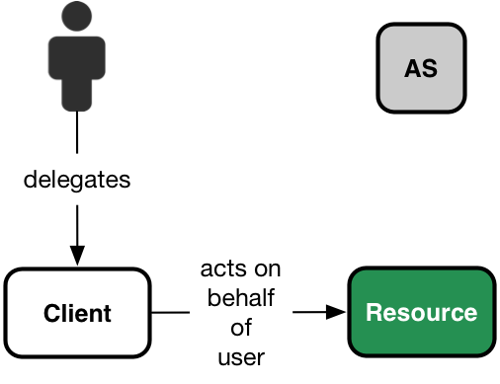
OAuth delegation
In the picture above we have the usual OAuth roles:
- The user (or resource owner, in OAuth terminology);
- A resource server, ie. a service hosting user resources, capable of accepting and responding to protected resource requests using access tokens.
- A client: this is an agent that has received a permission from the user to act on his behalf on his resources hosted on a resource server;
- An authorization server: a service that issues access token to clients after having authenticated the user and obtained an authorization from the user that the client is entitled to act on user’s resources
There are scenarios when a resource server, in order to satisfy a client request, needs to access resources hosted by other downstream services on behalf of the user, like in the following picture:
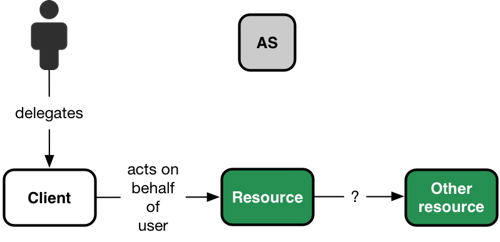
OAuth token exchange
In OAuth, access tokens are bearer tokens, so the first resource server could simply use the access token received from the client to interact, on behalf of the user, with the downstream resource server.
There are, however, situations in which just using the received access token against the downstream service is not possible, like for instance if the token audience was scoped to be valid only on the first resource server.
Moreover, the resource server could need the ability to act on behalf of the user for an unbounded amount of time (e.g., to implement long-running computations), not limited by the validity of the received access token.
The token exchange specification was designed to provide a protocol in support of these scenarios, where a client can exchange an access token received from antoher client with a new token (or a set of tokens, as we will see) by interacting with a trusted OAuth authorization server.
Impersonation vs delegation
As specified in the Token Exchange OAuth specification, when a subject A impersonates B, A has all the rights of B and it is indistinguishable from B. So, when A interacts within any other entity, A is B.
With delegation A still has its own identity, separate from B. So when A interacts within another entity, it is explicit that A is representing B, because B has delegated some of its rights to A.
More details about the difference from this two semantics can be found in this section of the specification.
The INDIGO IAM token exchange implementation currently supports only impersonation semantics.
Client configuration requirements
In order to request a token exchange, a client must be configured with the
urn:ietf:params:oauth:grant-type:token-exchange grant type enabled. The token
exchange grant type is disabled by default for dynamically registered
clients, and can be enabled only by users with administrative privileges.
Furthermore, one can restrict the token exchange actor such that upscoping isn’t enabled.
Here, the definition of upscoping being that one requests for additional scopes that is not present in the original token.
However, to clarify, both actor and subject must have the requested scopes enabled.
In this context the disabling of upscoping restricts the actor to only request scopes present in the token, but the
scopes requested must be enabled for both subject and actor. For any token exchange, the scopes requested must be present
on subject- and actor client.
It’s important to note that the disabling of upscoping enforces all the requested scopes to be present in the
access token, except for the offline_access scope. The disabling of upscoping does not restrict this scope from
being upscoped (though the offline_access scope would still have to be enabled for both subject and actor client).
Per default upscoping is enabled, but given administrator privileges one can disable upscoping for a client.
This can be done in the scope segment, when configuring the client as seen below:
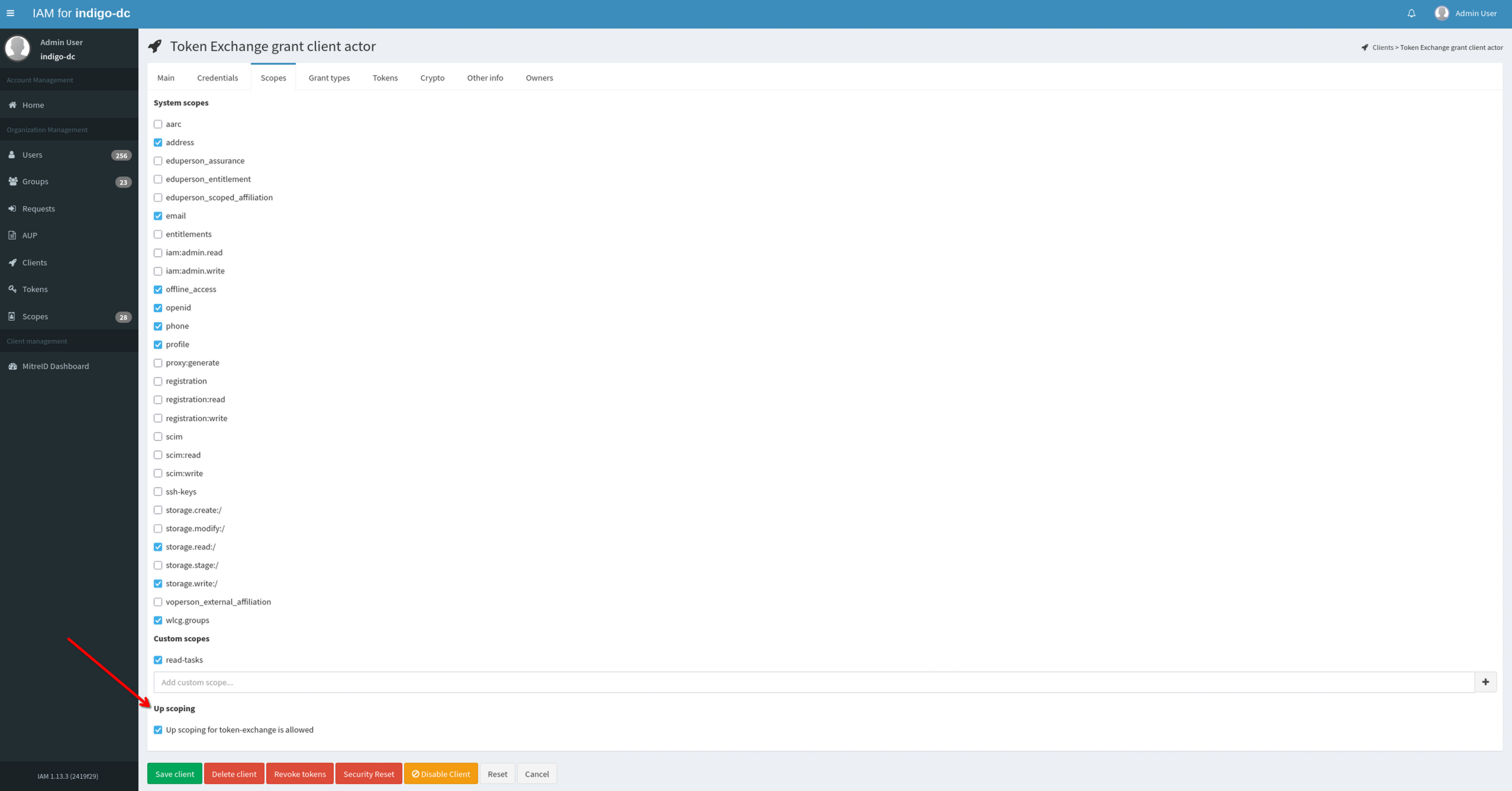
Lastly, it should be mentioned that the default behaviour is to extract the scopes from the access token. If no scopes are present in the access token (which is a possibility given the versatility of the configuration of access tokens within Indigo IAM), then token introspection will be used to retrieve the scopes of the token and a warning will be produced, signaling this.
The token exchange request
A client who wants to exchange an access token with a new one (or a couple of
new tokens, in case a refresh token is requested), must send an authenticated
request to the IAM /token endpoint, specifying the following properties:
| Parameter | Value |
|---|---|
| grant_type | urn:ietf:params:oauth:grant-type:token-exchange |
| subject_token | The subject access token that the client wants to exchange |
| scope | The set of scopes requested for the new access token |
| audience | Optional. A space-separated list of resource identifiers that will be used to limit the audience of the issued token |
Scopes in exchanged tokens
A client, when requesting a token exchange, can request any of the scopes enabled by its client configuration. IAM system scopes are however handled in a special way. These scopes, in order to be “exchanged” across clients, need to be
- enabled for the client requesting the token exchange
- enabled for the client who is the subject of the token exchange
- linked to the subject token presented for the token exchange (only if the client requesting does not have upscoping enabled)
The list of system scopes currently defined in the IAM can be obtained by registered users by issuing a request to the IAM system scopes API:
curl -H "Authorization: Bearer ..." https://iam.example/api/scopes
Token Exchange example
This section describes a token exchange flow.
We start with a normal OAuth flow where a client, token-exchange-subject,
requests an access token from the IAM using the resource owner password
credential flow. The token-exchange-subject client is configured to use HTTP
basic authentication against the IAM token endpoint, and in this example acts
on behalf of the test user. We use the resource owner password credentials
flow for convenience, but any other OAuth or OpenID connect flow that involves
a user identity would be fine (i.e., authorization code).
$ export IAM_TOKEN_ENDPOINT=https://iam.local.io/token
$ export SUBJECT_ID=token-exchange-subject
$ export SUBJECT_SECRET=...
$ export USERNAME=test
$ export PASSWORD=...

$ curl -s -u $SUBJECT_ID:$SUBJECT_SECRET \
  -d username=$USERNAME \
  -d password=$PASSWORD \
  -d grant_type=password \
  -d scope="openid profile" \
  $IAM_TOKEN_ENDPOINT | tee /tmp/response | jq
Note that the only scopes requested in this first request are openid and
profile, i.e. the scopes required to access user identity information. IAM
token endpoint returns a JSON containing an access token and other info:
{
  "access_token": "eyJraWQiOiJyc2ExIiwiYWxnIjoiUlMyNTYifQ.eyJzdWIiOiJhY2JjY2QwOC1kNzNkLTQxZjItODk3MS1iNjA4ZmNjNjYyNmQiLCJpc3MiOiJodHRwczpcL1wvaWFtLmxvY2FsLmlvXC8iLCJleHAiOjE0NzY5NTcxMDIsImlhdCI6MTQ3Njk1MzUwMiwianRpIjoiMjBiZThlNjYtNmNmOS00YzE0LWI4ZDEtZjJmZTc0NDk0YjAxIn0.kqAhZ2MNmBLYIA_-xW9356kD-ndqJ7jKUZRPb7ox_4iXbjcnV6oZYAHZzTH_uBTXA2WsVIJJ-Qicm5JQ0ydb2ewgECAmGkKfL3X4qnnRq2_GgZZof3zlM_rIz3QrDB3v1eIt42YeMdUgODUYGKeDwntT5a7wPDtxe-GM2uL5fik",
  "token_type": "Bearer",
  "expires_in": 3599,
  "scope": "openid profile",
  "id_token": "eyJraWQiOiJyc2ExIiwiYWxnIjoiUlMyNTYifQ.eyJzdWIiOiJhY2JjY2QwOC1kNzNkLTQxZjItODk3MS1iNjA4ZmNjNjYyNmQiLCJhdWQiOiIzMmMzMTUyOS05YmM2LTQ1ZWQtYjU0YS0wNGEyNThiMDRmYmYiLCJraWQiOiJyc2ExIiwiaXNzIjoiaHR0cHM6XC9cL2lhbS5sb2NhbC5pb1wvIiwiZXhwIjoxNDc2OTU0MTAyLCJpYXQiOjE0NzY5NTM1MDIsImp0aSI6IjhhMzk1OTM5LTM1N2QtNGY5My04MmEzLTJkMTBkM2ZhMzgzZCJ9.DtNR-ob8kMIUMa2x6TW7krSYMt78tfr5fnTK4aeoIY-wmEWcjPRx1_vT6_lesjMr9w0B_OCALXfOoDBfbF7DhmV7vpbotirkMxvowFBzgppmtBTZNAzLc_Wiwr4IAiGydwjy_UbYrxx6qlWJAKRwzSbDDd3oDVpU-KM8gtLIEa8"
}
We put this access token in an environment variable:
$ export SUBJECT_TOKEN=$(cat /tmp/response | jq -r .access_token)
We use this access token to access the app API, which only requires access to
user identity to grant access:
curl -H "Authorization: Bearer $SUBJECT_TOKEN" https://app.example.org/api
Suppose now that the app API needs, to properly answer the request from the
client, to interact with another downstream service, https://tasks.example.org,
on behalf of the user. Unfortunately the set of scopes linked to the access
token received are not sufficient to do this, and so app decides to exchange
the token received with another one granting enough privileges.
In Token Exchange terms, here app is the actor, the subject identity linked
to the token is the test user, and the audience for the new token being
requested would be the https://tasks.app.example.org/api API.
So app would do a request like the following:
$ export ACTOR_ID=https://app.example.org/api
$ export ACTOR_SECRET=...
$ export AUDIENCE=https://tasks.example.org/api

$ curl -s -u $ACTOR_ID:$ACTOR_SECRET \
    -d grant_type=urn:ietf:params:oauth:grant-type:token-exchange \
    -d audience=$AUDIENCE \
    -d subject_token=$SUBJECT_TOKEN \ # This token was received from the initial client
    -d scope="openid profile read-tasks" \
    $IAM_TOKEN_ENDPOINT | tee /tmp/response | jq
Note that app requests an additional scope, read-tasks, to interact with
the downstream service.
Since app is a trusted client for token exchange, the IAM responds with the
following JSON:
{
  "access_token": "eyJra...",
  "token_type": "Bearer",
  "expires_in": 3599,
  "scope": "openid profile read-tasks",
  "issued_token_type": "urn:ietf:params:oauth:token-type:jwt"
}
And app can use the newly issued access token to invoke services on
https://task-app.example.org/api on behalf of user test:
$ curl -H "Authorization: Bearer eyJra..." http://tasks.example.org/api
Upscoping during Token Exchange example
Below is presented a guide on how to do upscoping using the default clients
enabled in Indigo IAM.
## The goal

# To perform a token exchange with a subject to provide initial token with scope X
# and an actor to use said token to get a new token with scope Y using upscoping

## Setting the variables

export IAM_TOKEN_ENDPOINT=localhost:8080/token

## Getting the access token

curl $IAM_TOKEN_ENDPOINT -d grant_type=client_credentials -d client_id=token-exchange-subject -d client_secret=secret -d scope=openid

## Setting the access token just received

export ACCESS_TOKEN=...whatever you just received


## Doing the token exchange
curl $IAM_TOKEN_ENDPOINT -u token-exchange-actor:secret -d subject_token=$ACCESS_TOKEN -d grant_type=urn:ietf:params:oauth:grant-type:token-exchange -d scope="profile" -d subject_token_type=urn:ietf:params:oauth:token-type:access_token
Trust
Clients that have the token exchange grant enabled are considered trusted clients i.e., no explicit grant from the user is needed to grant access to client scopes. For IAM system scopes, however, these can be “exchanged” only if linked to the original subject token.
Limitation and known issues
The current implementation of Token Exchange in Indigo IAM has the following limitations:
- Delegation is not yet supported: if
actor_tokenor thewant_compositeparameters are specified within the request, an error response is returned by the authorization server; - The
resourcefield is ignored.